The Big Public Transport Survey: Supporter guidelines

The Big Public Transport Survey: Supporter guidelines
About the survey
Mencap is running a national
survey
 A survey is when someone asks you to answer some questions.
about public transport for people with a
learning disability
A learning disability is to do with the way someone's brain works. It makes it harder for someone to learn, understand or do things.
in the UK.
This will be a chance for people with a learning disability to tell us about their experiences using public transport and everyday lives. We will be asking questions on other topics too, such as wellbeing, community A community is the people and places in an area. and work. The results will help Mencap to provide better support and further improve the lives of people with a learning disability.
Survey participants
The survey is for adults (aged 18+) with a learning disability who live in the UK. Some people with a learning disability will be able to complete the survey by themselves. Other people might need some help to complete the survey. They might need a
support worker
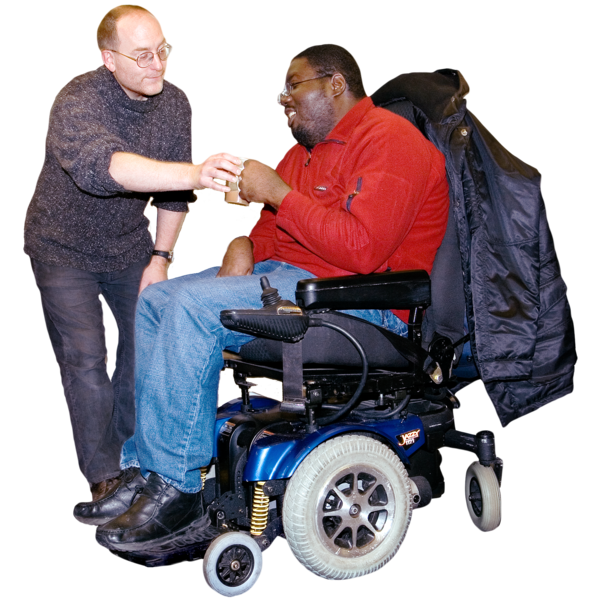 Support workers are people who are paid to give care and support to people who need it.
, carer, family member, friend or somebody else to support them.
If the survey is not
accessible
 Accessible means something is easy for people to use or join in with. For example: Accessible writing means the writing is easy to read and understand.
for somebody you are supporting, there are lots of other ways they can take part! For example, this could be through an
interview
 An interview is a meeting where you talk to someone or a group of people about something. When you have an interview for a job, you have to answer questions and say why you would be good at the job. The person who gives the best answers is offered the job.
, conversation or even drawing a picture. To arrange this please:
- Email: [email protected]
- Or phone 0207 454 0454.
Tips for supporters
Thank you for offering to support somebody to complete the survey. We have put together some tips to make this easier for you:
- Decide where the conversation should take place
Before getting started with the survey, talk to the individual about where they want to complete it. It is important that this is a place where the individual feels comfortable enough to talk about their life and experiences. This may be a place where there is enough privacy or a place that they are already familiar with.
- Make sure the individual feels at ease
It is essential that the individual feels at ease when they are completing the survey. Before you start, discuss how you are going to fill in the survey. Some people might want to read and fill in the survey themselves, whereas others might want you to do this. Allow enough time for them to answer each question – they should not feel under pressure to complete the survey as quickly as possible. Take breaks if needed, and maybe put the kettle on before you get started!
- Make it feel like a conversation
If you can make filling in the survey more of a conversation, then this will make it much more fun! Rather than just reading out the questions and answer options, you can talk around the topics and encourage respondents to answer questions in their own words first before prompting them with the answer options. The answer they give is likely to be quite close to one of the answer options provided in the survey. Of course, everybody is different, and so you will need to adapt the style of the conversation to the person!
- Use picture response scales if needed
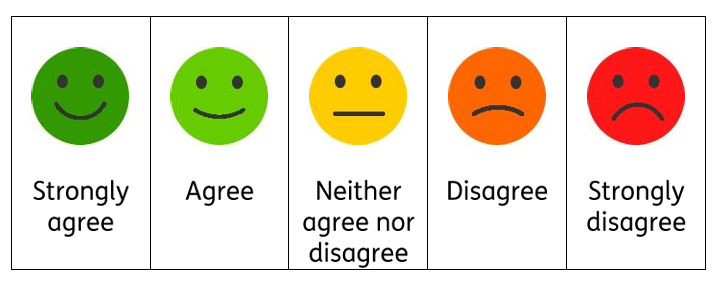
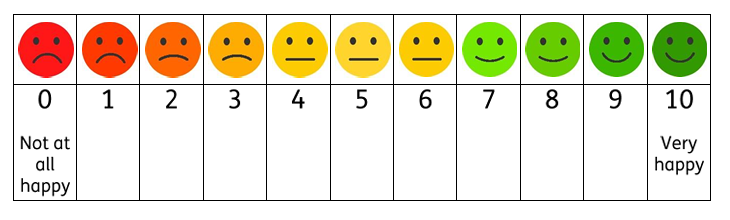
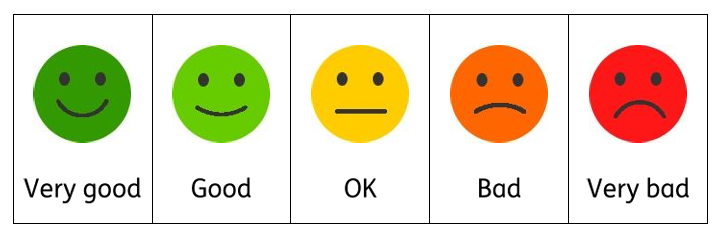
You will see that some questions in the survey use response scales, such as a 5- point scale from 'Strongly agree' to 'Strongly disagree'. Some people might find it easier to answer these questions using pictures. At the bottom of this resource, we have created some picture scales for you to use to help people answer these questions.
If an individual does not seem to understand the response options, even when using the picture scale, then please skip these questions.
- Read through or practice beforehand
You might like to read through the survey questions before supporting somebody to fill it in. Or you might like to practice administering the survey with a colleague, family member or friend before supporting somebody to fill it in.
Gaining and maintaining informed consent
It is essential that you ask the individual whether they are happy to take part in the research Research is a way of finding out information which could come from books, or asking people what they think. . Before doing so, you need to go through the ‘information about this survey’ section at the very beginning of the survey. This will help you to provide the individual with important information about things like confidentiality, and how Mencap will use any data collected. After you have gone through this information with the individual, please check whether they have understood and retained it.
It’s really important that you explain there will be no bad or negative consequences if somebody decides not to take part, to skip a question or to stop answering questions at any time.
Whilst you are supporting the individual to complete the survey, please check they are happy to continue as you go on. Somebody may change their mind mid-way through, and they should be able to stop answering the questions if they want to.
Reporting concerns
For most people, completing the survey will give them an opportunity to talk about how their life is now and the things that will help to improve this. However, it is possible that whilst you are supporting somebody to complete the survey, they will disclose something concerning.
Please report any concerns to Mary Peachey, the Motability project’s Research Lead, by emailing [email protected]. If you work for Mencap or another
organisation
 An organisation are a group of people who work together.
, please additionally follow all relevant protocols and
safeguarding
Keeping people safe from being hurt, abused, or neglected is called Safeguarding.
policies, as appropriate.
Further sources of support
To get support you can contact Mencap's Learning Disability Helpline. It offers free advice and support for people with a learning disability, their families and carers. Just phone 0808 808 1111 or email [email protected]
If you're in Northern Ireland, phone 0808 808 1111 (and select option 2) or email [email protected]
If you're in Wales, phone 0808 808 1111 (and select option 3) or email [email protected]
You can also talk to Mencap's Research team about any of the topics included in this survey.
Email: [email protected]
Picture scales for you to use to help people answer the survey questions
This Easy Read Easy Read is a way of making written information easier to understand. Pictures are usually added next to the writing. was first published 30/09/2024.
Last updated: 30/09/2024.